
Zazbaat - Text-Based Social Platform
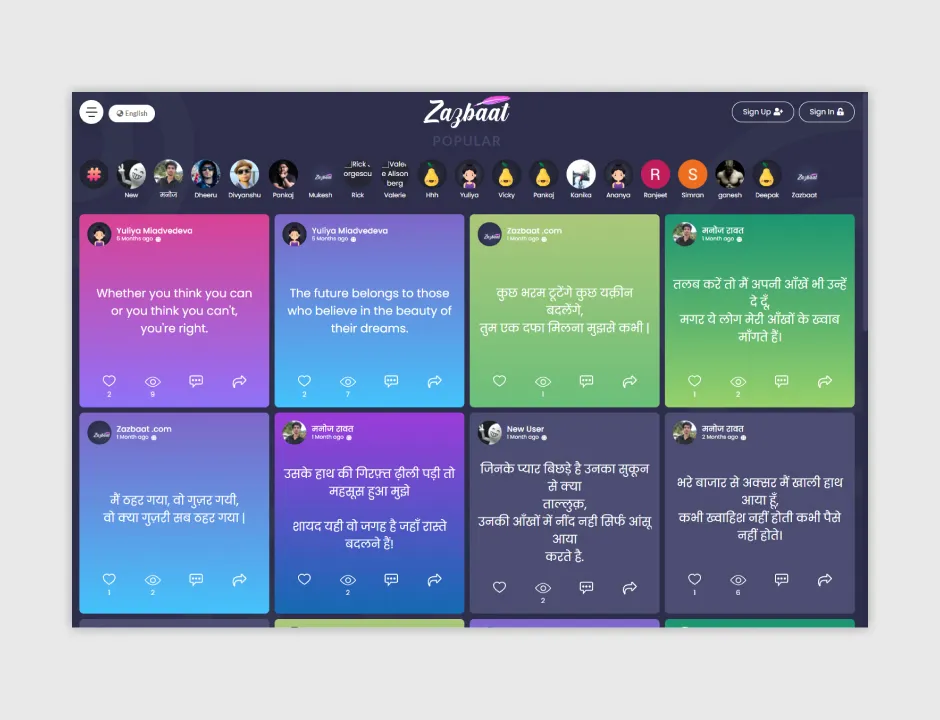
A custom-built, full-stack social network engineered for writers. This project tackles complex relational data modeling, dynamic DOM state management using jQuery, and custom text parsing to deliver a seamless, text-first user experience.
servlet jsp
Monolithic MVC
MySQL
Java
The Vision & Architecture
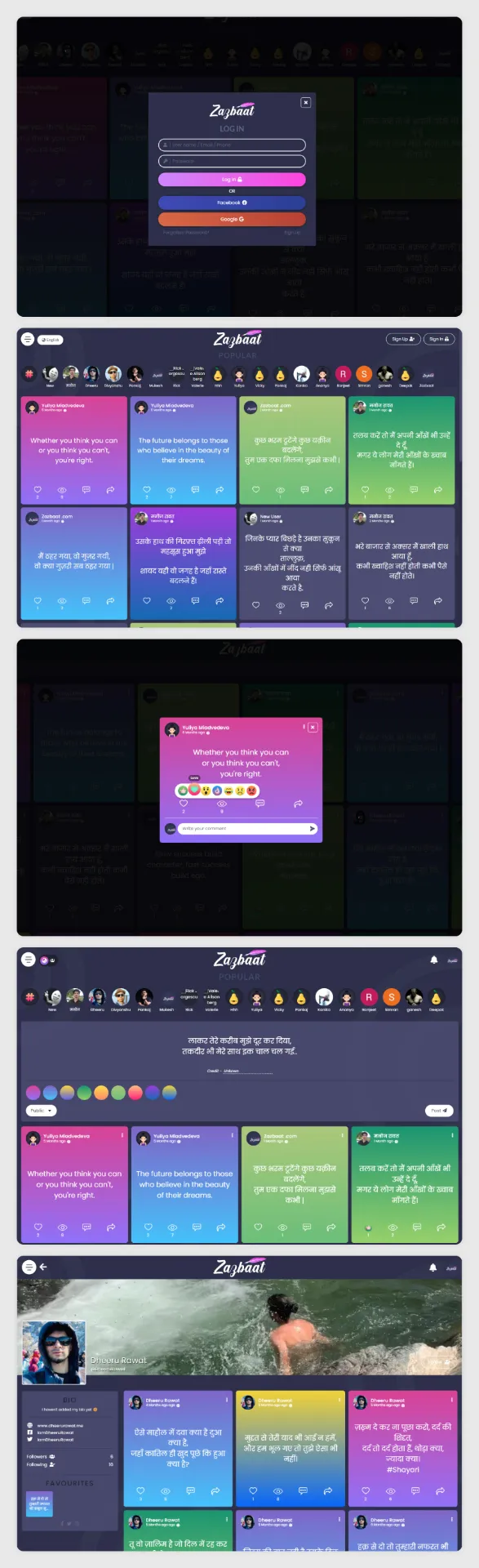
Zazbaat was engineered from the ground up as a dedicated social networking monolith tailored for writers, poets, and shayari enthusiasts. Rather than relying on a modern JavaScript framework, I built the entire stack using Java Servlets, JSP, and MySQL, with jQuery driving the client-side interactivity. The architectural goal was to create a highly relational, text-first application that could handle complex social interactions—such as nested comments, multi-tiered sharing, and personalized feeds—while maintaining strict data integrity.
Building this system end-to-end served as a massive catalyst for my engineering growth, forcing me to confront and solve core problems in state management, database optimization, and secure data handling without the safety net of high-level abstractions.
Core Engineering Challenges & Technical Implementations
1. Managing Client-Side State Before the Virtual DOM
The Problem: Creating a dynamic feed where users could like, comment, and share posts without triggering full-page reloads presented a significant DOM manipulation challenge. Without a framework like React to manage state, interacting with one post frequently caused UI bleeding, where the wrong elements would update.
The Solution: I engineered a strict, dynamic ID binding system. By appending relational database primary keys directly to HTML elements during the JSP server-side rendering phase (e.g., id="post-123-like-btn"), I created isolated DOM boundaries. My jQuery event listeners were then designed to extract these unique identifiers on the fly, package them into asynchronous AJAX payloads, and update only the targeted local DOM nodes upon receiving a successful 200 OK response from the Servlet.
2. Database Optimization & Relational Complexity
The Problem: The initial database schema was drafted entirely on paper. As the platform's feature set grew to include granular visibility toggles (Public vs. Friends-Only feeds), user tagging, and recursive post sharing (tracking the original author across multiple shares), the SQL queries became highly complex. This led to severe performance bottlenecks and slow feed generation times.
The Solution: I dove into database performance profiling. By analyzing the query execution plans, I identified missing indexes on high-traffic foreign keys and timestamp columns. Implementing strategic B-tree indexing drastically reduced full-table scans, dropping feed load times significantly. This phase also taught me how to properly structure relational joins to prevent the N+1 query problem.
3. Global Character Encoding & Data Sanitization
The Problem: A text-first social network must reliably handle diverse global languages and emojis. Early on, any non-Latin characters inputted by users were aggressively corrupted into garbled symbols upon rendering. Furthermore, rendering raw user input directly to the DOM exposed the application to Cross-Site Scripting (XSS).
The Solution: I traced the encoding corruption down to the default MySQL configuration. I executed a full migration of the database schema and connection strings from standard latin1 to utf8mb4, guaranteeing full Unicode and emoji support. Simultaneously, I implemented strict server-side data sanitization and prepared statements to neutralize SQL injection vectors, alongside output encoding to mitigate XSS vulnerabilities.
4. Custom Text Parsing & Language Processing
The Problem: I wanted to implement a Twitter-style trending hashtag system and allow users to filter content by language, but I lacked an out-of-the-box solution.
The Solution: I wrote a custom background parser in Java that intercepted post payloads before database insertion, using regular expressions to extract hashtags, normalize them, and map them to a relational tracking table. For language detection, I integrated the Apache Tika library. This introduced me to the nuances of Natural Language Processing, particularly when Tika struggled to differentiate between regional dialects sharing the Devanagari script (like Hindi and Nepali). I had to implement fallback logic and user-defined overrides to ensure accurate content categorization.
Outcome & Retrospective
While Zazbaat is no longer live, it remains the foundational pillar of my software engineering journey. It forced me to look under the hood of web development, understand the raw HTTP request/response lifecycle, and manually engineer features that modern libraries now handle automatically. The problem-solving methodologies and architectural patterns I developed here directly inform how I design scalable, modern systems today.